
How it works
Devexana reads sources, stores records on the appliance, and uses those records to answer questions with citations.
- Available
- Scheduled reads from read-only sources; file imports; search by meaning and keyword; reranking; answers from the local model
- In production use
- Scheduled reads from Aruba/HP AOS-S switches, Barracuda CloudGen firewalls over SSH, and Freshservice
- Off by default
- Listeners for syslog, SNMP traps and NetFlow (settings syslog_listener_enabled, snmptrap_listener_enabled, flow_listener_enabled)
On this page
Devexana runs as one service on the appliance. By default, llama.cpp serves the language models on the appliance. Your staff connect to Devexana with a web browser on the local network.
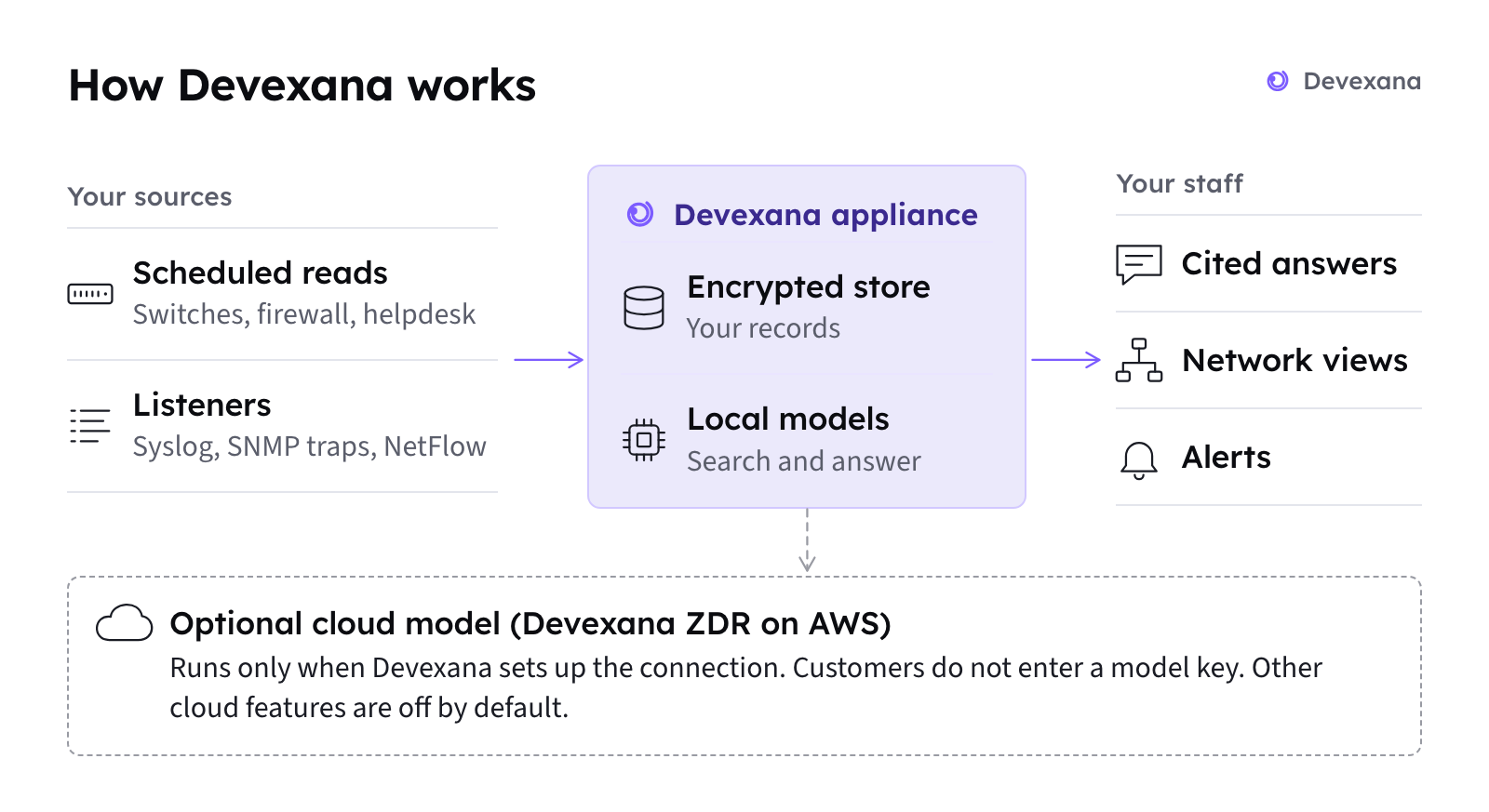
The appliance
The appliance runs two parts:
- The Devexana service. It reads sources, stores records, answers questions, and runs background work.
- The model engine. llama.cpp serves the language models, and llama-swap loads and unloads them. The model engine listens on the appliance's loopback address only.
How Devexana is delivered describes the appliance and how Devexana delivers it.
Getting data in
Devexana takes in data on four paths.
| Path | What it does | Setup and defaults |
|---|---|---|
| Read-only sources | Devexana reads switches once a day. The default interval for other scheduled source reads is 15 minutes | An administrator adds each source and approves each read function |
| Listeners | Listeners receive syslog, SNMP traps and NetFlow or IPFIX. They cannot send | Off until an administrator turns each one on |
| File imports | CSV, TSV, XLSX, PDF, DOCX, Markdown and text files become records that answers can cite | A person uploads each file |
| Site file | Your site file places buildings and closets on the campus map | You maintain the file |
The default switch read is the running configuration, once a day. A wider set of read commands is an installation setting. Switches over SSH and SNMP lists the commands.
Storing it
Devexana keeps every record in one database on the appliance. SQLCipher encrypts the database. The audit log is inside the same database.
The search index is a separate file on the appliance. The application does not encrypt the search index file. Encryption and credentials lists what is encrypted and what is not.
Answering a question
Devexana first decides whether the question needs stored records or is general chat. For questions that need records, Devexana uses five stages.
- Devexana searches the stored records by meaning, by keyword and by the links between records.
- A reranking model on the appliance puts the results in order.
- The local model writes the answer from the records it receives.
- Deterministic checks remove person names and dates that are not in the source records. The checks also mark answers that contain other unsupported details.
- Devexana turns each numbered marker in the answer into a citation. Each citation shows how fresh its record is.
A citation shows which record Devexana used to build the answer. It does not prove every sentence. See Cited answers.
The network views
The campus map and the switch faceplate use the same stored records as the answers. Network views: campus map and switch faceplate describes each view.
Background work
Scheduled reads, Routines, backups and listeners run inside the Devexana service. Devexana needs no separate queue or database server.
What can leave the appliance
Where the AI runs names each cloud feature and what it sends. Outbound connections: the complete list lists the outbound connections and their defaults.
Limits
What Devexana does not do (limitations) lists every limit.
Applies to Devexana release 0.3.182. Page updated 2026-10-20. Questions or corrections: support@devexana.com.